 Lifesciences


Enterprise Content Management gets thrown around a lot. Compliance teams talk about it. CIOs budget for it. But the term actually means different things to different people, and that confusion has the chance to cost regulated organisations millions.
This guide aims to cut through the noise. We’ll explain what ECM actually is today (not what it once was), why it matters when you’re operating under regulatory pressure, and how it differs from the systems you might already have in place.
What is Enterprise Content Management?
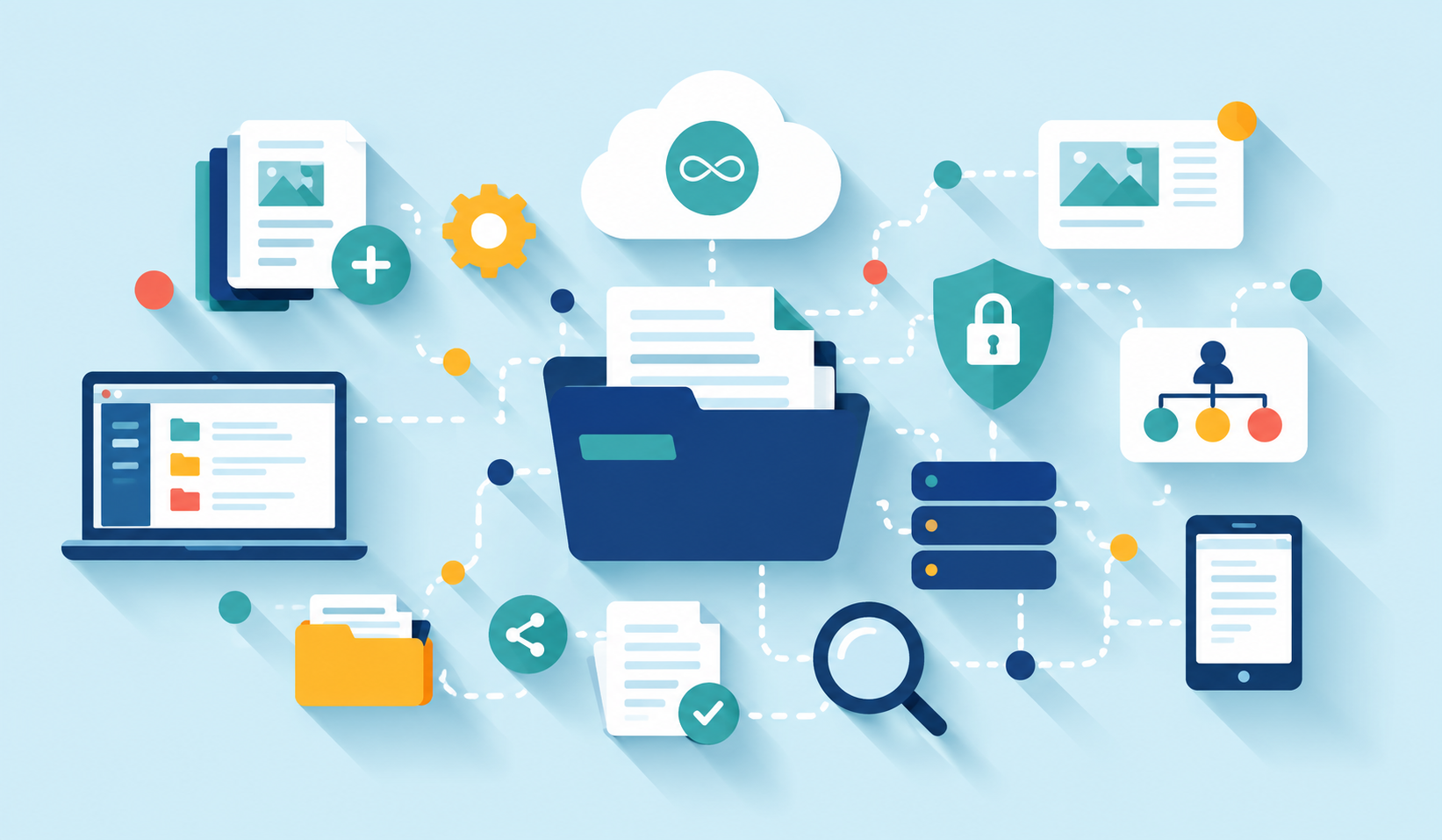
Enterprise Content Management, or ECM, is a platform that does three things: it stores your content (documents, emails, records, data), it manages access and governance around that content, and it connects that content to your business processes.
The keyword here is enterprise. This isn’t a basic file storage system. ECM is built for organisations with thousands of users, millions of documents, complex compliance requirements, and multiple systems that need to talk to each other.
A good ECM system does something critical that most storage solutions don’t: it embeds governance and control into the platform itself. Not as an add-on. Not as a separate module you bolt on later. Built in from the ground up. This matters because regulated industries can’t afford systems where compliance is optional.
Why regulated industries need ECM
If you’re in financial services, life sciences, manufacturing, aerospace, or government, you deal with regulatory frameworks that touch every part of how you manage information. GDPR, HIPAA, SEC regulations, ISO standards, FDA requirements. The list goes on.
These frameworks all demand the same things: you need to know where your content is. You need to prove who accessed it and when. You need to enforce who can access what. You need to maintain version history. You need to be able to retain or destroy content according to policy, not on a whim.
A spreadsheet can’t do this. Cloud folders can’t do this. Even most document management systems treat compliance as an afterthought. ECM systems are built for this specific problem.

ECM vs. Document Management vs. File Storage
The boundaries between these categories blur, but the differences matter.
File Storage (Dropbox, SharePoint, Google Drive) does one thing: it keeps your files accessible and backed up. It’s cheap, it’s simple, and it breaks immediately when you need proper governance or compliance controls. You’re responsible for organising folders, managing access manually, and hoping no one deletes something important.
Document Management Systems add structure. They enforce filing rules, version control, and basic access permissions. But they’re still fundamentally passive. They store and retrieve. They don’t connect to your workflows. They don’t automate approval processes. They don’t talk to your other systems.
Enterprise Content Management goes further. It’s active. It enforces retention policies automatically. It routes documents through approval workflows. It integrates with your CRM, your ERP, your business applications. It manages metadata so your content is actually findable and usable, not just stored. And compliance isn’t a feature you enable but how the system is designed to work.
Core capabilities of a modern ECM
Compliance controls built into the platform
Audit trails that record every action. Retention policies that automatically delete or archive content when it’s time. Legal hold capabilities that freeze documents when litigation hits. Role-based access controls that ensure only the right people see sensitive information. These aren’t plugins, they’re core to how the system operates.
Workflow and process automation
Documents don’t just sit there. They move through approval processes. They trigger notifications. They’re automatically routed to the right person based on rules you’ve defined. This reduces manual steps and enforces consistency across your organisation.
Metadata and classification
Content is tagged with the right metadata so it can be found, governed, and processed correctly. In regulated industries, this is critical. Misclassifying a document can mean it gets the wrong retention period, or the wrong access controls. A modern ECM makes classification either automatic or enforced.
Integration with other systems
Your ECM doesn’t exist in a vacuum. It needs to connect to your CRM, your financial systems, your case management platform, your HR system. A modern ECM can integrate with anything, either through APIs or through low-code connectors that don’t require custom development.
Cloud-native architecture
Modern ECM is cloud-first. It scales automatically as your volume of content grows. Security updates and new features roll out without downtime. You don’t have servers to maintain. You don’t have capacity planning headaches. You access it from anywhere, on any device.

When do you actually need ECM?
You need ECM when one or more of these is true:
You’re a regulated organisation
If your industry has compliance frameworks that touch how you manage information, you can’t afford to treat content management as an afterthought. Good management of enterprise content should be a business requirement. The cost of non-compliance (fines, legal action, reputational damage) far outweighs the investment in a proper system.
Your content volume is significant
If you’re managing thousands or millions of documents across multiple locations, a filing system breaks down. You need a system that can scale, search across billions of records instantly, and enforce policies across everything automatically.
You have complex workflows
If content needs to move through approvals, if different teams need to collaborate on documents, if you need to enforce handoffs between departments—manual management doesn’t scale. You need automation and routing built into the platform.
You’re running legacy systems that don’t talk to each other
If you have information scattered across email, file servers, old ECM systems, and custom databases, you’re managing content fragmentation. ECM gives you a central hub that can pull information together and serve it to the systems that need it.
The future of ECM in regulated industries
ECM isn’t a solved problem. The technology is evolving faster than regulation, which creates opportunity.
Artificial intelligence is starting to change how content is classified and processed. Machine learning can identify patterns in your content that humans would miss. Automated extraction can pull structured data from unstructured documents. These aren’t on-the-horizon features anymore, they’re available today.
But the fundamentals won’t change. Regulated organisations will always need systems where compliance is non-negotiable. Where every action is audited. Where access is enforced. Where content doesn’t disappear by accident. Good ECM is built on this foundation, and no amount of AI changes that.
The platforms that win in regulated industries are the ones that treat compliance as the baseline, rather than a feature. Everything else from automation and integration to scalability only builds on top of that.
Ready to explore ECM for your organisation?
If any of this resonates, you’re probably at the point where a proper ECM could make a real difference. The CARA Platform is built for regulated industries from the ground up. Compliance isn’t optional. It’s how the platform works.
Start a conversation with our team about your specific needs.