Lifesciences


Manufacturing has always run on documentation. Work instructions, quality records, supplier certifications, engineering change orders. The paperwork has simply moved from filing cabinets to shared drives over the past couple of decades, but how that paperwork is governed hasn’t kept up.
Think of a work instruction like the recipe for a dish a restaurant serves every day. If the recipe changes, every chef in every kitchen needs the new version, the manager needs to know who who approved the change and when, and if the change affects something like an allergen, the business needs to be able to show that too. A shared drive can store the recipe. It has no way of telling you which version was in the kitchen on a given Tuesday, or whether someone is still working from the old one.
That’s the position a lot of manufacturers are in today, often without realising it.
Where generic file storage falls short
Most manufacturers manage their documentation through shared drives, generic cloud storage, or a point solution bolted onto the ERP system. These tools store files perfectly well. But proving, on demand, that the right version of a document was in use at the right time, approved by the right person, is a different job entirely.
Take version control for instance. In a shared drive, that usually means a “last modified” timestamp and not much else. An approval chain, if one exists at all, tends to live in an email thread rather than anywhere the system itself enforces. Neither of these gaps tends to cause a problem on an ordinary day (though they do force users to waste time searching). They tend to surface during an audit, in front of a customer quality team, or after a nonconformance, which is the moment a manufacturer can least afford to be caught out.
The pressure is building
A few things are converging at once. Major manufacturers are pushing stricter supplier quality standards further down their supply chains. Standards like ISO 9001, AS9100, and IATF 16949 are being audited more frequently and in more depth. Manufacturers are digitising faster than their document governance is keeping pace with, which widens the gap between what a system can technically do and what a properly controlled process actually requires.
The cost of that gap is concrete. A failed audit can mean a lost certification. A lost certification can mean a lost contract, particularly with customers who treat supplier quality certification as a condition of doing business at all.
What “compliance-driven” document management means
A compliance-driven document management system starts from a different assumption to a generic one: that any document may, one day, need to be defended in front of an auditor, a regulator, or a customer.
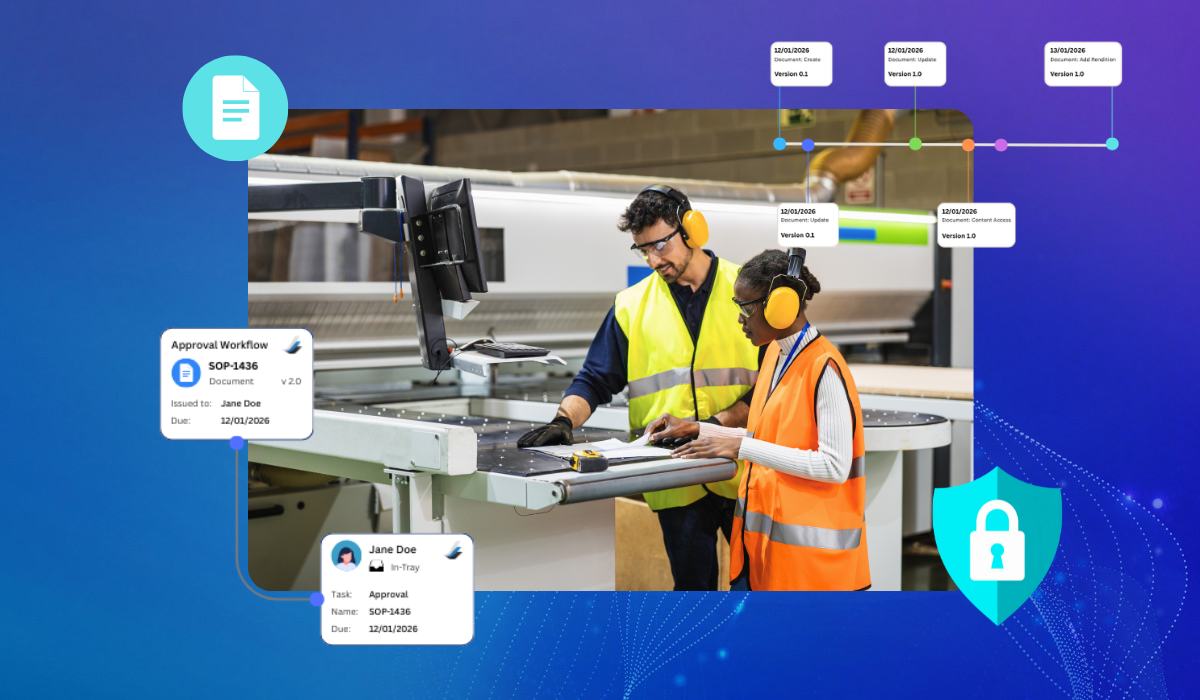
That assumption changes the architecture. Version control, approval workflows, and audit trails become how the system behaves by default, rather than something a team configures after the fact or reconstructs under pressure. The CARA Platform was built around this principle, bringing document management, business process automation, and audit-ready traceability together in one place, rather than asking manufacturers to stitch those capabilities together themselves.
The real question to ask
The manufacturers who navigate this well treat compliance as the foundation the rest of the system sits on, built in from day one rather than added after a failed audit.
The question worth asking is whether your current system can prove, on demand, exactly what was approved, by whom, and when. Storing the document was never the hard part.
Find out more about the CARA Platform’s Document Management capabilities here.